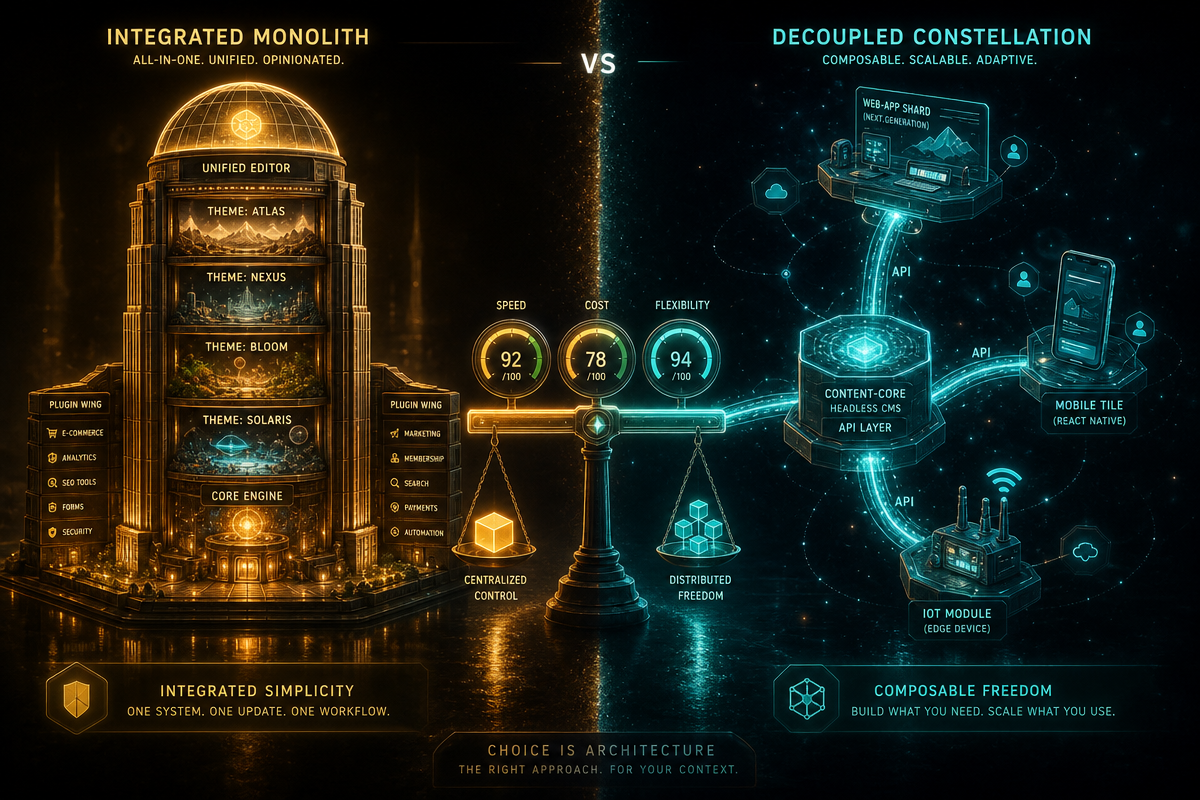



Right now, if you’re a business owner staring down a website rebuild, the honest answer to “custom or WordPress?” isn’t philosophical – it’s arithmetic. Every developer who’s shipped both knows the custom-website-vs-wordpress debate isn’t really about which technology is “better.” It’s about whether your specific business problem is common enough that someone else has already solved it for you, or unusual enough that you need to solve it yourself. Most businesses assume the answer is obvious. It isn’t, and getting it wrong wastes tens of thousands of pounds either way.
Here’s the provocative bit: WordPress is the right choice for the overwhelming majority of small and mid-sized businesses, and custom development is the right choice for a much smaller slice than most agencies will admit. Knowing which camp you’re in before you sign a contract is the whole game.
What’s the real difference between a custom website and WordPress?

Image: Tectera
A custom website is code written specifically for one business, with no shared template or content management system (CMS – the software layer that lets you edit content without touching code) underneath it. Developers build it from the ground up using HTML, CSS, and JavaScript for the front end, and languages or frameworks like PHP, Python, React, Next.js, Laravel, or Django to handle logic, data, and server behaviour. Nothing is inherited. Every button, every form, every database query is written for your business and only your business.
WordPress, by contrast, is a pre-built CMS that over 41.9% of all websites globally run on as of 2026 – meaning four in ten sites you visit today are built on the same underlying software. That scale matters practically: it’s why there’s a plugin for almost anything you’d want to do, and why thousands of developers know the platform well enough to fix it fast when something breaks. WordPress comes in two flavours worth distinguishing. WordPress.org is the free, self-hosted version – you supply your own hosting and domain, but you get full control over themes and plugins. WordPress.com is a managed hosted service – easier to set up, but with real limits on customisation once you outgrow the basics.
So what does this mean day to day? With custom code, there is no dashboard someone forgot to lock down, no plugin update that silently breaks your checkout page. With WordPress, there’s no developer on retainer required just to fix a typo in your homepage copy. Those aren’t minor conveniences – they’re the entire decision, restated as a trade-off between control and accessibility.
Where does each option actually win – and where does the marketing overstate it?
Custom code wins decisively on performance and control, and the evidence is measurable rather than anecdotal. Custom-coded sites are leaner because they carry no unused plugin bloat, no generic theme CSS fighting your design – which is why they routinely hit Lighthouse performance scores of 90-100 (Google’s automated audit tool that scores page speed and best practices out of 100). That’s the difference between a page that loads in under a second and one that makes a mobile visitor wait three or four seconds and bounce. Custom builds also give you complete control over functionality: a booking system that matches your exact operational workflow, analytics tracking built for your specific funnel, integrations that don’t depend on a third-party plugin author keeping their code maintained. If our recent piece on What Replaced PHP? The Truth About Modern Web Development in 2026 taught us anything, it’s that the frameworks doing this work today – Next.js, Laravel, Django – are dramatically more capable than the PHP-only stacks of a decade ago.
But here’s the myth that needs busting: “custom means better SEO” and “custom means more secure” aren’t automatically true – they’re true only if built well. WordPress sites are often criticised as security liabilities, and it’s a fair criticism when plugins go unpatched, but the vulnerability is in the plugin ecosystem, not the CMS itself. A well-maintained WordPress site with Wordfence (a WordPress security plugin) and disciplined updates can be just as safe as an unmaintained custom build with a stale dependency nobody’s watching. The real difference is that custom sites are less vulnerable to plugin-related security breaches specifically – there’s no third-party plugin marketplace introducing surface area you don’t control. That’s a genuine advantage, but it’s narrower than the marketing copy suggests.
On the accessibility and content side, WordPress’s ecosystem is hard to overstate: thousands of themes (pre-built design templates) and plugins like Yoast SEO for search optimisation and WooCommerce for eCommerce mean a non-technical shop owner can launch a fully functional store without writing a line of code. That’s not a limitation – for most businesses, it’s the entire point.
The trade-off most business owners underestimate until it’s too late
Cost and timeline are where the custom-website-vs-wordpress decision gets real, and this is the part sales pitches gloss over. Professional custom builds run roughly $15,000-$50,000 or more, with timelines stretching from one to six months depending on scope. WordPress builds, by comparison, can go from brief to launch in weeks, often for a fraction of that budget – especially when using established themes and plugins rather than heavy customisation. If you’re budgeting for a rebuild this quarter, that gap alone should shape your shortlist before you even look at features.
The trade-off people miss isn’t the sticker price, though – it’s what happens after launch. WordPress lets non-technical users log in and edit a page themselves, the way you’d adjust a shop’s window display without calling a contractor. Custom sites demand ongoing developer-supported maintenance for updates, bug fixes, and scaling – every content change, every new feature, routes through a developer. That’s not a flaw, it’s a structural fact: you’re trading day-to-day independence for long-term architectural control. Businesses that don’t budget for that ongoing relationship are the ones who end up with an expensive custom site frozen in amber six months after launch, because nobody accounted for the fact that “custom” means “someone has to keep building it.”
Think of it like the difference between buying a flat-pack wardrobe and commissioning a bespoke fitted one. The flat-pack option is fast, cheap, and you can rearrange the shelves yourself on a Sunday afternoon. The bespoke wardrobe fits your exact room and needs precisely – but if you want a shelf moved, you’re calling the carpenter back, not doing it yourself. Neither is wrong. They solve different problems for different budgets.
There’s also a compliance dimension worth flagging for public-sector or regulated businesses: if your site needs to meet strict accessibility standards, our WCAG Accessibility Testing: Essential 2026 Guide and the ADA Title II guidance on web and mobile accessibility both apply regardless of platform – but a custom build gives you more direct control over exactly how those standards get implemented, rather than depending on a theme’s underlying markup.
So, back to the opening claim: is WordPress really the right call for most businesses, and custom only for the few? Yes – with one caveat. The decision isn’t about which platform is objectively superior, it’s about matching your growth stage, budget, and technical appetite to the tool that removes friction rather than adding it. If your business runs on standard content, standard eCommerce, and standard workflows, WordPress’s ecosystem will get you live faster and cheaper, and you’ll be able to manage it yourself. If your business runs on something genuinely unusual – a booking system nobody’s built before, performance requirements that themes can’t hit, workflows that don’t map to any plugin – that’s when the custom investment pays for itself. Know which business you are before you brief the build.
If you’re weighing that decision and want an honest read on which side of the line your project falls on, DRS Web Development builds custom websites and web applications for businesses of all sizes. Get in touch for a free consultation and we’ll help you work out which route actually saves you money.
Frequently Asked Questions
Q: Is a custom website always faster than WordPress?
A: Custom-coded sites often achieve Lighthouse performance scores of 90-100 because they carry no unused plugin or theme bloat, but a well-optimised WordPress site can still perform well if it’s built and maintained carefully.
Q: How much does a custom website cost compared to WordPress?
A: Professional custom builds typically cost $15,000-$50,000 or more with timelines of one to six months, while WordPress sites can launch in weeks for significantly less using existing themes and plugins.
Q: Can I edit my own website if I choose WordPress?
A: Yes, WordPress is designed so non-technical users can update content, pages, and design directly through its dashboard, whereas custom sites typically require a developer for most changes.
Q: Is WordPress less secure than a custom website?
A: WordPress itself isn’t inherently less secure, but its vulnerability often comes from outdated or poorly maintained plugins, whereas custom sites avoid that specific risk since they don’t depend on a third-party plugin ecosystem.
Q: What’s the difference between WordPress.org and WordPress.com?
A: WordPress.org is free and self-hosted, giving you full control over themes and plugins but requiring your own hosting and domain, while WordPress.com is a managed hosted service that’s easier to set up but limits customisation.
Source: https://tectera.com/custom-website-vs-wordpress/
This article was researched and written with AI assistance, then reviewed for accuracy and quality. Riya Shah uses AI tools to help produce content faster while maintaining editorial standards.
Need help with your web project?
From one-day launches to full-scale builds, DRS Web Development delivers modern, fast websites.