

Woocommerce runs a checkout in seconds flat – a shopper taps “buy,” a card gets charged, a confirmation email lands. That speed is deceptive. Behind it sits months of decisions, and those decisions are why three agencies can quote the same brief and land thousands apart. Ask a developer why, and you’ll hear the same phrase every time: it depends. That’s not a dodge. It’s the honest answer.
A quick note on the figures below: most WooCommerce cost research is published by US agencies, so the source data is priced in dollars. Converted and cross-checked against UK agency day rates, the practical ranges for a UK small business land at roughly £400-£2,400 for a DIY starter build, £2,400-£6,400 for a theme-based store, £6,400-£20,000 for a semi-custom build, and £20,000-£65,000+ for full custom development. Treat these as planning bands, not quotes – get a written estimate before budgeting against them.
What determines woocommerce development cost
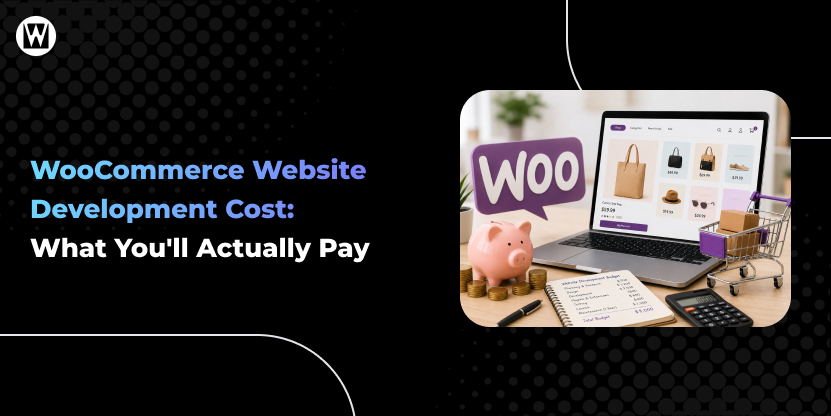
Image: WebyKing (webyking.com blog)
WooCommerce development cost is driven entirely by the work wrapped around a free plugin, not by the plugin itself. WooCommerce costs nothing to install – it’s free, open-source, and sits on top of WordPress. Think of it like a shipping container: free to acquire, but the ship, the crane, the warehouse, and the crew that move it around cost real money. The bill comes from design, development, hosting, plugins, integrations, product setup, and the maintenance that keeps it all running afterwards.
Every one of those line items is a variable, not a constant. A store owner picking a pre-built theme and uploading twenty products manually pays a fraction of what an owner needing an ERP connection, B2B pricing tiers, and custom shipping logic pays. Same plugin. Wildly different projects. That’s the part buyers miss when they treat “how much does a WooCommerce site cost” like a single number instead of a range shaped by scope.
Why three quotes for the same brief can differ by thousands
Quotes diverge because WooCommerce is modular – nobody is buying a fixed package, they’re buying a configuration. Four variables, repeated across nearly every credible cost breakdown, push a quote from the bottom band into the top one: what the store needs to do, how much existing data has to migrate across, how custom the design must look, and who’s building it. A freelancer charges differently than an agency; an agency charges differently than a DIY build with paid help bolted on. None of those choices are wrong – they just aren’t comparable line items, which is exactly why side-by-side quotes can look like apples versus spaceships.
Here’s the split buyers rarely see broken out: agency fees are labour, priced by day rate or fixed scope. Plugin and theme licences are a separate, much smaller cost – typically £50-£300 a year each for premium extensions like advanced shipping rules or subscription billing. Operational running costs are a third bucket again, and the one most commonly left out of a budget entirely. Confusing these three is how a client ends up asking why a “£3,000 website” needs another £2,000 a year to stay online.
Myth worth busting here: a higher quote doesn’t automatically mean padding or overcharging. A developer factoring in data migration, custom shipping rules, and integration testing is pricing a genuinely different project than one quoting a theme install. This is the same reasoning that separates a WordPress and off-the-shelf build from a fully custom one – scope, not markup, drives the gap.
A worked example: mid-size UK homeware store
Take a realistic brief – a homeware retailer, 200 products, three variant options each, needs Stripe and PayPal checkout, Royal Mail shipping rules, and a migration from an existing Shopify catalogue. A semi-custom build might break down like this: UX/UI design and theme customisation £3,500, WooCommerce setup and product data migration £2,800, payment gateway and shipping integration £1,600, cross-browser and load testing £900, and project management £700. That’s roughly £9,500 in one-time development – comfortably inside the semi-custom band, and higher than the theme-based band because of the migration and dual-gateway work specifically, not because of scope creep. So what: when a quote comes in above a “typical” figure you’ve seen online, ask which of those line items is driving it before assuming you’re being overcharged.
The cost split people forget to budget for
Most cost conversations miss that WooCommerce spending splits into two separate budgets: one-time development and ongoing running costs. Development covers planning, UX/UI design, the WordPress and WooCommerce setup itself, theme customisation or bespoke coding, and product data entry. Running costs are the recurring bill afterwards, and they cover more ground than hosting alone: managed WordPress hosting and SSL typically run £20-£100 a month, plugin and theme licence renewals £10-£40 a month averaged across the year, payment processing fees (Stripe and PayPal both sit around 1.5-2.9% plus a small per-transaction charge, so a £50,000-a-year store loses roughly £1,000-£1,500 to fees alone), automated off-site backups £5-£15 a month, security monitoring and malware scanning £10-£30 a month, and a retainer for ongoing plugin updates, performance checks, and accessibility fixes – often £100-£300 a month for a developer to own that properly rather than leaving it to chance. Add UK VAT registration and Making Tax Digital-compliant accounting software if turnover crosses the threshold, and running costs for an actively-maintained mid-size store commonly land at £150-£400 a month once every category is counted, not just hosting.
That gap matters more than it looks. Shopify bundles hosting, backups, and basic security into its monthly plan fee, which starts from around £25-£30 a month for the entry tier at current UK pricing – though Shopify plan pricing and included features do change periodically, so check current listings before comparing. WooCommerce’s lower headline hosting cost is the trade-off for assembling that stack yourself, or paying a developer to assemble and maintain it. Buyers who compare WooCommerce’s £20-a-month hosting bill against Shopify’s all-in monthly fee are comparing a partial cost to a bundled one – factor in backups, security, and payment fees on both sides before deciding which is actually cheaper for a given store.
A performance note practitioners learn the hard way: a WooCommerce store with 200+ products and no caching or image optimisation will start dragging on checkout speed within months, and slow checkout is lost revenue, not just a technical nuisance. Budget for a caching plugin, a CDN, and image compression from day one rather than retrofitting them after conversion rates dip.
So: why do three WooCommerce quotes vary by thousands? Because you’re not comparing three prices for one product – you’re comparing three different projects wearing the same name. The plugin is free; the decisions around it, and the ongoing work to keep the store fast, secure, and compliant, aren’t. Get clear on scope, data, design ambition, and who’s building before requesting quotes, and the “it depends” answer stops feeling evasive and starts feeling accurate. If you’re weighing platform choice more broadly, it’s also worth reading how custom development compares to off-the-shelf options before committing either way.
If you’d rather skip the guesswork, DRS Web Development builds custom websites and web applications for businesses of all sizes – get in touch for a free consultation.
Frequently Asked Questions
Q: How much does a WooCommerce website cost in 2026?
A: For a UK small business, planning ranges span roughly £400-£2,400 for a DIY starter build to £65,000+ for enterprise projects, with most small-to-mid businesses paying £2,400-£20,000 depending on customisation and integrations.
Q: Why do WooCommerce development quotes vary so much between agencies?
A: Because WooCommerce is modular and open-source – buyers aren’t purchasing a fixed package, so scope decisions like design customisation, data migration, and integrations change the price for what are effectively different projects.
Q: Is WooCommerce cheaper to run than Shopify?
A: Often, but not always – WooCommerce’s own hosting and licence costs are typically £20-£100 a month, but once backups, security monitoring, and payment fees are added, running an actively-maintained store can reach £150-£400 a month, which narrows the gap with Shopify’s bundled plan pricing considerably.
Q: What’s the difference between agency fees, plugin licences, and running costs?
A: Agency fees are one-time labour for design, build, and integration. Plugin and theme licences are separate annual renewals, typically £50-£300 each. Running costs are the ongoing monthly spend on hosting, backups, security, and payment processing that continues for as long as the store operates.
Q: What factors most affect WooCommerce project pricing?
A: The store’s required functionality, the volume of data being migrated, how custom the design needs to be, integration and testing requirements, and whether a freelancer, agency, or DIY approach builds it.
Q: What ongoing costs do store owners commonly forget to budget for?
A: Payment processing fees, automated backups, security monitoring, performance optimisation as the catalogue grows, and UK tax compliance software – all separate from the headline hosting bill.
Source: https://www.webyking.com/blog/woocommerce-website-development-cost/
This article was researched and written with AI assistance, then reviewed for accuracy and quality. Riya Shah uses AI tools to help produce content faster while maintaining editorial standards.
Need help with your web project?
From one-day launches to full-scale builds, DRS Web Development delivers modern, fast websites.