


Last updated: August 3, 2026
PHP was supposed to be dead by now. Or so you’d think, scrolling through developer forums. The reality of modern web development 2026 is considerably stranger – and more useful to understand.
Here’s the provocative bit: PHP still powers roughly 72-75% of all websites with a known server-side language, including Facebook, Wikipedia, WordPress, Etsy, and Mailchimp. If that number surprises you, you’ve been reading the wrong headlines.
The real question isn’t “what replaced PHP?” – it’s “what took the roles PHP was never great at?”
What “Replacing” a Language Actually Means in Practice

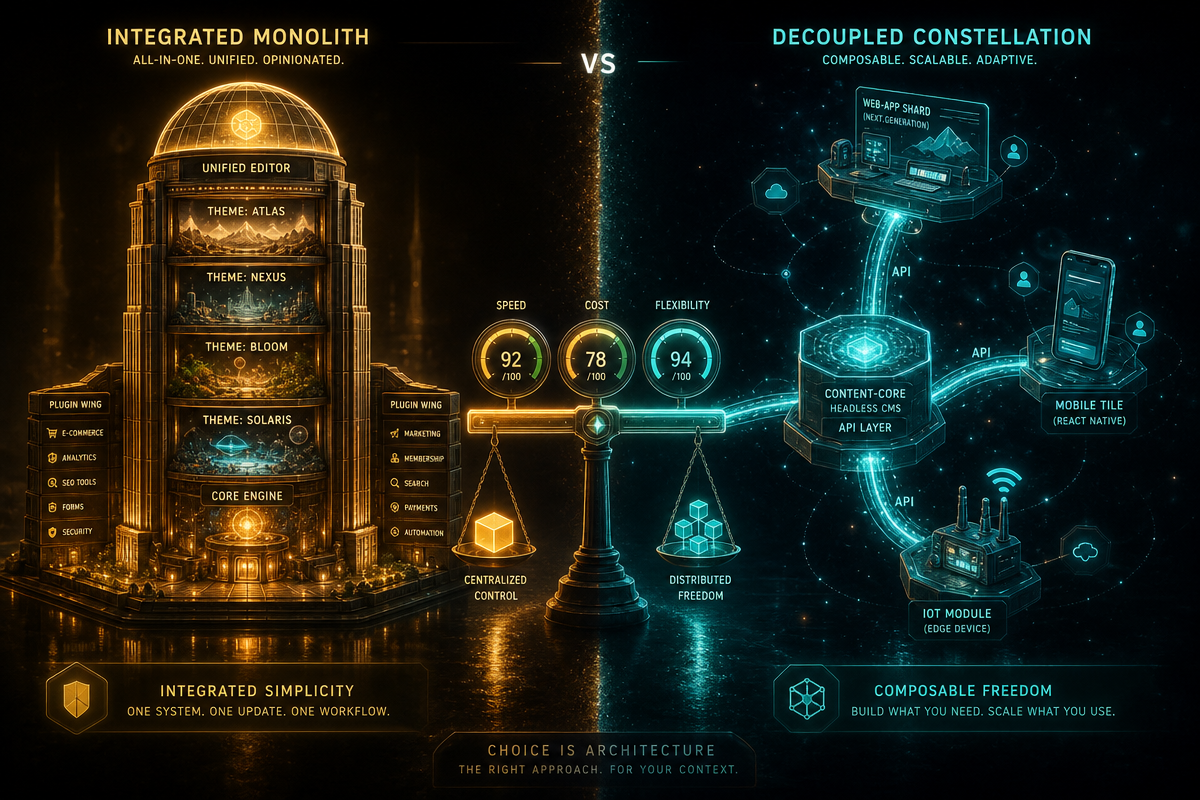
Image: Arachnid Web Solutions / Landon Cromwell (SpiderDesign.me.uk)
No language gets replaced cleanly. They lose ground in specific niches, gain it in others, and the overall landscape fragments. That’s exactly what’s happened in 2026.
PHP’s role has shifted rather than collapsed. It remains the workhorse for content-heavy sites and small-to-medium business applications, where its ecosystem – WordPress, Laravel, Symfony – offers enormous productivity advantages and a deep talent pool. PHP 8.1 and 8.2 brought significant performance improvements and better memory management, narrowing the gap with newer runtimes for typical web workloads. It didn’t stand still.
Think of it like a city’s road network. New motorways get built for high-speed traffic, but the original streets still carry most of the daily commuter load. The old roads didn’t disappear – they just stopped being the only option.
The Challengers That Actually Took Ground
Node.js made the most significant structural dent. By enabling server-side JavaScript, it unified front-end and back-end development under a single language – a genuine productivity win for teams already deep in JavaScript. Frameworks like Express.js and NestJS provide structure and scalability that previously required switching languages entirely. Where Node.js genuinely excels is high-concurrency, real-time use cases: chat applications, collaborative tools, live dashboards. Its non-blocking I/O model – meaning it handles multiple requests without waiting for each one to complete – handles thousands of simultaneous connections where PHP’s traditional request-per-process approach would struggle.
Python, via Django and Flask, has effectively displaced PHP in data-science and AI-adjacent niches. That’s not a close contest. Python’s data-processing ecosystem is simply unmatched. If you’re building anything that touches machine learning, analytics pipelines, or AI integrations, you’d have a hard time making a serious case for PHP. For a deeper look at how these two compare on real workloads, see our PHP vs Python: Performance And Features Compared breakdown.
Go and Rust have taken the infrastructure end. Go handles microservices and distributed systems well – readable, fast, with excellent concurrency primitives. Rust, via frameworks like Actix and Axum, goes further: memory safety without garbage collection, adopted by Cloudflare and Dropbox for critical parts of their stacks. Neither is competing with PHP for a WordPress installation. They’re operating in the performance-critical backend tier PHP was never designed for.
The Legacy Debt Nobody Talks About
Here’s the nuance most language comparison articles skip entirely: the 2026 State of Open Source Survey found nearly 25% of teams still running PHP 7.3 or earlier in critical applications. Those versions reached end-of-life in 2021. No security patches. No fixes. Still in production.
The modern tooling conversation assumes teams are on current versions. Many aren’t. If you’re planning a rebuild, your website redesign checklist should include a hard look at runtime versions before any discussion of new languages or frameworks. Accessibility standards have similarly moved on – WCAG accessibility testing requirements in 2026 apply regardless of what language your backend runs, and legacy deployments often carry both risks simultaneously.
So, Should You Migrate Away From PHP?
Back to the developer staring at their PHP codebase, wondering if they’re building on the wrong foundation. The answer is: it depends on what you’re building – not on what’s trending.
PHP on a modern runtime, with a well-maintained framework, is a perfectly valid choice for content sites, e-commerce, and business applications in 2026. Node.js makes sense if your team is already JavaScript-native and you’re building real-time features. Python wins if data or AI sits at the centre of your product. Go and Rust earn their complexity for infrastructure work at genuine scale.
The death of PHP was always the wrong frame. The question was always which tool fits the job. In 2026, that question has more good answers than ever – which is precisely why the answer still, quite often, comes back to PHP.
DRS Web Development builds custom websites and web applications for businesses of all sizes, helping teams make the right technology choices for their specific needs. Get in touch at drs-web.co.uk/contact for a free consultation.
Frequently Asked Questions
Q: Has PHP actually been replaced in modern web development?
A: No – PHP still powers roughly 72-75% of websites with a known server-side language as of mid-2026, including major platforms like WordPress, Wikipedia, and Mailchimp. Its role has shifted rather than been eliminated, with newer languages filling specific niches like real-time applications (Node.js), AI and data science (Python), and infrastructure (Go, Rust).
Q: When should you choose Node.js over PHP?
A: Node.js is the stronger choice for high-concurrency, real-time use cases – chat applications, live dashboards, and collaborative tools – where its non-blocking I/O model handles thousands of simultaneous connections efficiently. PHP remains preferable for content-heavy sites and business applications with existing WordPress or Laravel codebases.
Q: Is PHP 7 still safe to use in 2026?
A: No. PHP 7.3 and earlier reached end-of-life in 2021, meaning no security patches are issued. Despite this, nearly 25% of teams surveyed in 2026 still run these versions in critical applications – a significant and active security liability.
Q: What language has replaced PHP for AI and data-science projects?
A: Python effectively displaced PHP in these niches, primarily through frameworks like Django and Flask. Python’s data-processing ecosystem – NumPy, Pandas, TensorFlow, and similar libraries – has no PHP equivalent, making it the default choice for any project with machine learning or analytics requirements.
Q: Are Go and Rust replacing PHP for typical business websites?
A: Not directly – they compete at different tiers. Go and Rust target infrastructure-heavy, performance-critical backends: microservices, distributed systems, and high-throughput APIs. For typical business websites and content management, PHP with a modern framework like Laravel remains a practical, well-supported choice.
Source: https://spiderdesign.me.uk/what-replaced-php-the-truth-about-modern-web-development-in
This article was researched and written with AI assistance, then reviewed for accuracy and quality. Riya Shah uses AI tools to help produce content faster while maintaining editorial standards.
Need help with your web project?
From one-day launches to full-scale builds, DRS Web Development delivers modern, fast websites.