

Last updated: May 29, 2026
Using the article:write skill to draft this article from the provided brief. All research context has been supplied inline, so proceeding directly to draft.
Most small businesses asking about WordPress website development cost are given a number that’s either embarrassingly low (someone on Fiverr) or suspiciously vague (an agency quote that arrives after three calls). Both leave you blindsided. The truth is that WordPress development costs sit on a spectrum from a few hundred pounds to tens of thousands – and the gap isn’t arbitrary. It maps almost perfectly to the complexity of what you’re actually building.
WordPress powers more than 40% of all websites on the internet. That ubiquity breeds a dangerous myth: that it’s cheap by default. In practice, the platform is free; everything else you bolt onto it costs money. Understanding where that money actually goes is what separates a business that budgets confidently from one that gets burned by scope creep and surprise invoices.
What a DIY or Low-Budget WordPress Site Actually Costs

Image: Simpalm
For personal or hobbyist sites, the baseline is genuinely accessible. Expect to spend £300-£800 getting a site off the ground, with annual recurring costs – domain registration, shared hosting, basic security, and maintenance – running £150-£400 per year. A premium theme (a pre-built design template you purchase and customise) costs £50-£200. Add a handful of free or low-cost plugins (modular add-ons that extend WordPress’s functionality), and you can have something respectable running for under £1,000 total.
That sounds reasonable until you look at what you’re trading away. DIY WordPress on shared hosting is the equivalent of renting a furnished bedsit: perfectly functional, but you’re constrained by someone else’s infrastructure and can’t knock down walls. The moment your traffic spikes, your loading times suffer. The moment you need a custom booking system or a members-only section, you’re either hacking together plugins that weren’t designed to coexist, or you’re hiring someone to fix the mess. You can explore the full landscape of options in our roundup of 15+ Web Development Platforms for Building Websites [2026] if you’re still at the platform-selection stage.
What Professional WordPress Development Actually Costs
Here’s where the numbers diverge sharply, and where most budgeting conversations go wrong.
A small business site built by a professional developer – think custom design, proper hosting configuration, contact forms, SEO foundations, and a CMS your team can actually use without a manual – runs £1,400-£4,100 upfront, with £450-£1,000 per year in ongoing costs. That ongoing figure covers hosting on a managed WordPress environment, plugin licence renewals, security patches, and periodic updates. Not optional. Skip it and your site becomes a liability.
E-commerce is where cost variance gets dramatic. A WooCommerce store (WooCommerce being the dominant WordPress e-commerce plugin, now powering a significant share of all online shops) costs £3,700-£22,200 to build initially, with £1,100-£2,300 per year in recurring expenses. That range isn’t vague – it reflects genuine complexity differences. A boutique selling 30 products needs far less than a retailer with 5,000 SKUs, automated stock feeds, multi-currency support, and a custom checkout flow. Plugin costs alone scale accordingly: enterprise builds can rack up £500-£1,000 in plugin licences annually, compared to near-zero for a basic personal site.
Custom enterprise WordPress – think multi-site networks, complex API integrations with CRM or ERP systems, bespoke theme design from scratch – sits at £6,000-£27,200 for initial development and £1,600-£3,000 per year to maintain. The maintenance figure isn’t padding; enterprise sites carry technical debt that requires active management. Integrations break when third-party systems update. Security posture has to be actively maintained, not assumed.
Where the Real Cost Differences Lie
The comparison that matters isn’t between a cheap site and an expensive site. It’s between the right solution and the wrong one, priced out over three years.
Consider custom theme design as a case study. A premium purchased theme costs £50-£200. A fully custom theme costs £1,000-£10,000+. That looks like a 50x difference, and it is – but the premium theme forces your brand into a mould it wasn’t designed for. You spend hours reverse-engineering someone else’s CSS. Your site looks like twelve other sites in your sector. You hit a wall when a client asks for something the theme doesn’t support natively. A custom theme is less like buying furniture and more like having the furniture built for the room: it fits because it was made to.
The same logic applies to plugin strategy. Stacking multiple overlapping plugins to replicate a feature that should have been built properly is a classic false economy. Each plugin is another attack surface, another update cycle, another potential conflict. Professional developers consolidate that complexity.
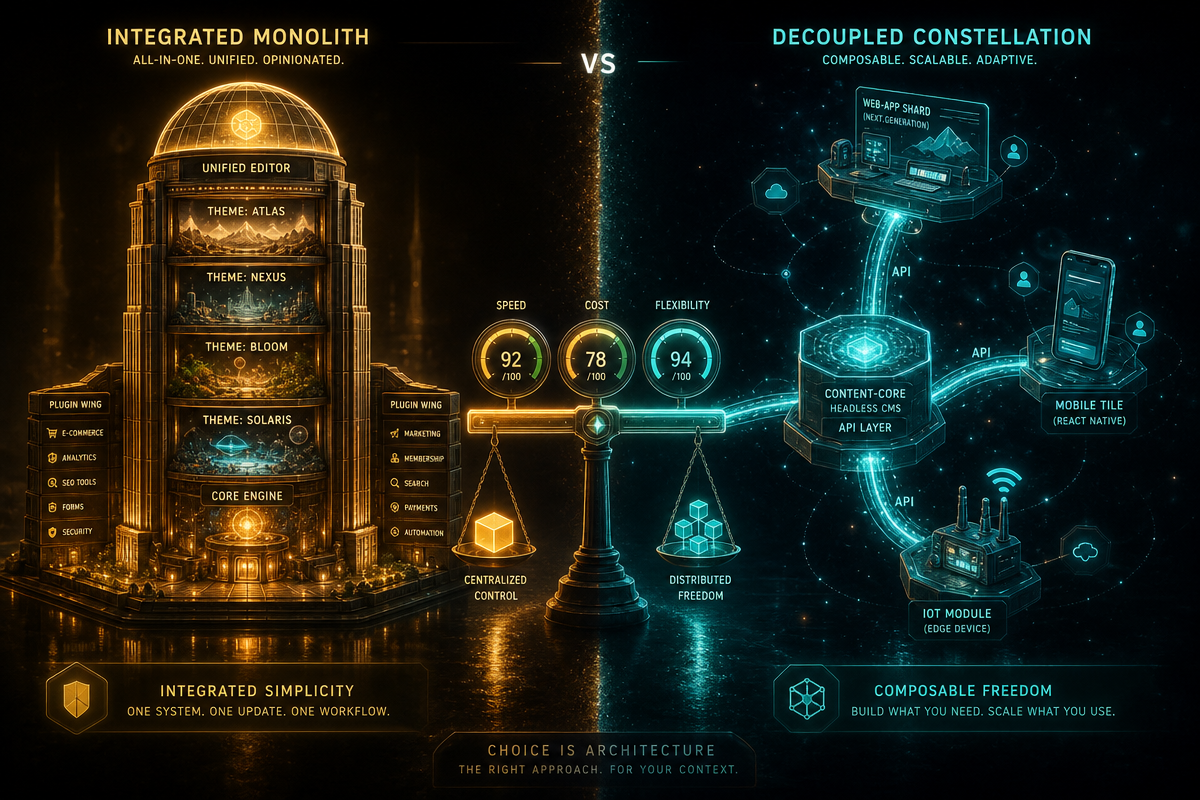
It’s also worth considering architectural choices at the outset. If you anticipate a future where your WordPress content feeds a mobile app, a third-party front-end, or multiple channels, using WordPress as a headless CMS – decoupling the content layer from the presentation layer – is worth exploring from day one rather than bolting on later. We’ve covered this in depth in WordPress as Headless CMS (2026 updated) (with Examples). Similarly, if performance or scalability is a primary concern for your use case, WordPress vs Jamstack in 2026: Which Should You Choose? lays out the honest trade-offs.
The Recommendation That’s Not a Cop-Out
Personal blog or portfolio with no commercial ambition? DIY WordPress on a quality shared host, a decent premium theme, and a few well-chosen plugins is genuinely the right call. Spend £500-£800 total and move on.
Small business with real customers to convert? Budget for professional development. The £1,400-£4,100 entry point isn’t excessive – it’s the cost of doing it properly the first time, rather than rebuilding in 18 months because the DIY version can’t support your growth. Factor in annual maintenance from day one; it’s not optional overhead, it’s operational infrastructure.
E-commerce or enterprise? Get a proper scoping conversation before anyone quotes you a number. The variance in that £3,700-£22,200 range is almost entirely determined by your specific requirements. A developer who quotes without scoping is guessing, and you’ll pay for the difference later.
The hidden cost nobody talks about is the opportunity cost of the wrong decision. A site that doesn’t convert, doesn’t rank, or breaks under load isn’t cheaper because it cost less to build.
If you’re ready to get a clear picture of what your project actually requires – not a ballpark, a real scope – DRS Web Development builds custom websites and web applications for businesses of all sizes. Get in touch for a free consultation and leave with a number you can plan around.
Frequently Asked Questions
Q: What is the average wordpress website development cost for a small business in 2026?
A: A small business WordPress site typically costs £1,400-£4,100 to build initially, with annual recurring costs of £450-£1,000 for hosting, maintenance, and plugin licences. The exact figure depends on the level of custom design and functionality required.
Q: Is a premium WordPress theme a good alternative to custom theme development?
A: Premium themes (£50-£200) are suitable for personal or simple sites with limited brand requirements. For businesses that need a distinct identity or custom functionality, a bespoke theme (£1,000-£10,000+) delivers better long-term value by eliminating workarounds and design compromises.
Q: Why do WooCommerce e-commerce sites cost so much more than standard WordPress sites?
A: WooCommerce stores require payment gateway integration, product management systems, stock and order workflows, security hardening for financial data, and often complex plugin stacks. The cost range (£3,700-£22,200) reflects genuine differences in catalogue size, customisation depth, and integration requirements.
Q: What ongoing costs should I budget for after my WordPress site launches?
A: Annual maintenance costs range from £150-£400 for personal sites to £1,600-£3,000 for enterprise sites. This covers managed hosting, security updates, plugin licence renewals, and WordPress core updates. Skipping maintenance is a security and reliability risk, not a cost saving.
Q: Can I build a WordPress site for free?
A: WordPress itself is free, but domain registration, hosting, security tools, and most quality plugins carry costs. A realistic minimum for a basic personal site is £300-£800 upfront plus £150-£400 per year – and that assumes you handle all setup and maintenance yourself.
Source: https://www.simpalm.com/blog/wordpress-website-development-cost
This article was researched and written with AI assistance, then reviewed for accuracy and quality. Riya Shah uses AI tools to help produce content faster while maintaining editorial standards.
Need help with your web project?
From one-day launches to full-scale builds, DRS Web Development delivers modern, fast websites.