

Image: Arachnid Web Solutions (Spider Design)
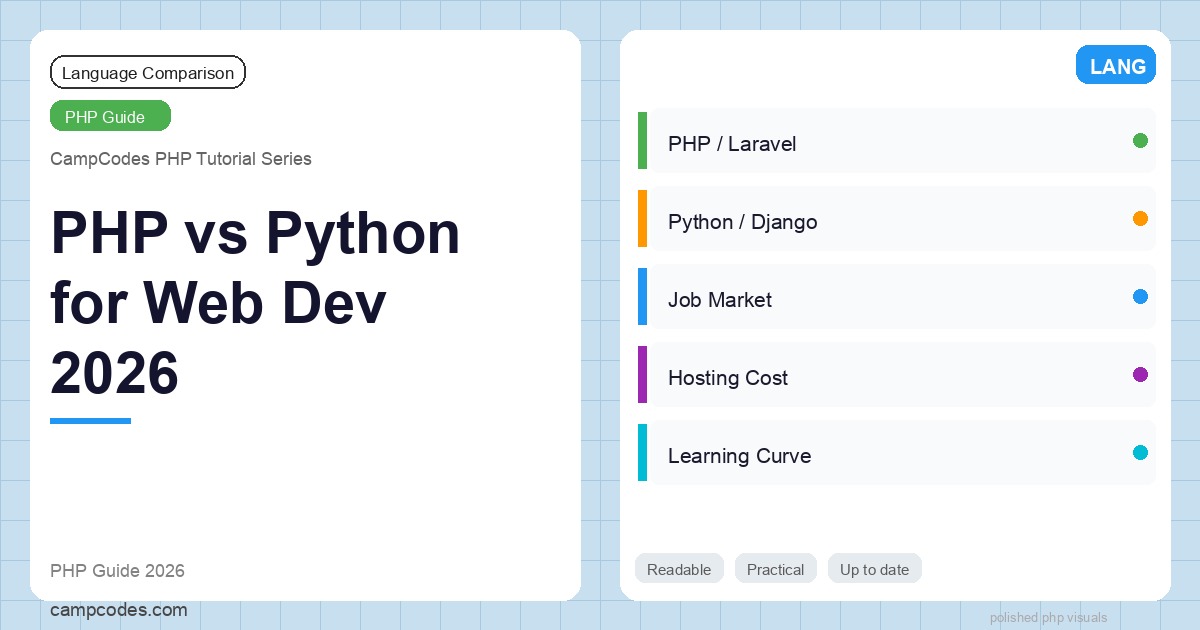
The wrong stack choice shows up in your sprint velocity before it shows up anywhere else. Slower MVPs. Security incidents that eat weeks. Developers who spend days wiring together infrastructure that should have shipped ready-made. This guide treats Django vs PHP as what it actually is in 2026 – a Django vs Laravel decision, with PHP as the ecosystem backdrop – and gives you four concrete criteria to score your specific project against.
Prerequisites
Image: Arachnid Web Solutions (Spider Design)
A working familiarity with server-side web development helps – you should know what routing and database access mean, even if you haven’t used both stacks. Have a project brief in mind, even a rough one. If you’re still at the planning stage, the Website Redesign Checklist for 2026 is a sensible first stop before committing to any technology decisions.
Step 1: Understand the Django vs PHP 2026 Comparison Properly
Django and PHP are not equivalent things – that’s the trap most comparisons fall into. PHP is a server-side scripting language powering over 75% of the web. Raw PHP is a blank sheet: maximum flexibility, no structure imposed. Django is a Python framework built on a “batteries-included” philosophy – it ships with an ORM (a way of querying your database using Python objects rather than raw SQL), an admin panel, authentication, URL routing, and form handling. All of it, out of the box.
The fairer comparison is Django versus Laravel, PHP’s most popular framework. Both impose structure. Both include ORMs and command-line tools. The gap narrows considerably – but it doesn’t disappear, and where it persists is exactly where your daily development rhythm is affected.
Step 2: What Actually Changes Day to Day
This is the question most comparison articles skip. Setup speed differs immediately. A new Django project reaches a working admin panel in two commands: python manage.py migrate creates your database schema, python manage.py createsuperuser adds a login-protected management interface. No boilerplate. No authentication wiring. A fresh Laravel install via Composer and Artisan is also quick, but requires additional configuration steps – choosing and installing an auth scaffold, wiring Breeze or Jetstream, configuring queues and mail if you need them.
Admin tooling is where Django’s lead is most visible. Django Admin ships as part of the framework and is usable without a line of custom code. Listing records, filtering, searching, inline editing of related objects – it’s all there. Laravel has Nova and Filament as first-class options, both excellent, but both require a separate installation decision. For internal tools and CRUD-heavy applications, this is a meaningful difference.
Maintenance risk over time also diverges. Django enforces a project structure that’s recognisable across every Django codebase – a developer joining from another Django project knows where the models, views, and URL config live. Laravel’s conventions are clear within a single project but allow more variation between teams. That variation compounds as a maintenance liability.
Before/after – CRUD-heavy internal app. A team building an internal stock-management dashboard for 30 staff chose Laravel initially. After six months, they’d written a custom admin interface, a bespoke permission system, and three separate authentication flows. Migrating to Django, the same feature set took three weeks. Django Admin handled the dashboard, the built-in permissions model handled access control, and the ORM handled data relationships. Ongoing maintenance dropped from a part-time dev to a few hours a week.
Before/after – cost-sensitive marketing site with custom features. A small agency building a multi-location restaurant site with online booking chose Django for its admin panel. Hosting on a VPS at £15/month versus shared PHP hosting at £3/month [citation needed] added up over two years. The booking logic was simple enough that Laravel would have delivered equivalent results at a third of the infrastructure cost. Django won on productivity; PHP won on budget. For a cost-sensitive project with a capable PHP developer already on the team, that calculus often points to Laravel.
Step 3: Match Your Security Requirements to the Right Stack
Django treats security as a first-class citizen. Protections against XSS (cross-site scripting), CSRF (cross-site request forgery), SQL injection, and clickjacking are on by default – you have to actively disable them to remove them. For most teams most of the time, this means a meaningful reduction in security surface area without any deliberate effort.
PHP’s security posture is more variable and depends on framework choice and team discipline. Laravel with a disciplined team can match Django’s security defaults closely – it includes CSRF protection and parameterised queries through Eloquent by default. Raw PHP without a framework is a different matter entirely: the responsibility falls entirely on the developer, and that’s where vulnerabilities tend to appear. Dismissing PHP on security grounds is too blunt; dismissing raw PHP without a framework is entirely reasonable.
If your project handles personal data, financial transactions, or anything governed by GDPR, Django’s secure-by-default approach reduces exposure from day one. It’s not that Laravel can’t achieve the same outcome – it’s that Django reaches it without requiring deliberate decisions about which protections to enable.
Step 4: Weigh Hosting Costs Against Development Speed
Here’s the trade-off that gets glossed over most often. PHP runs on virtually any shared hosting environment – a few pounds a month. Django requires a WSGI server (Web Server Gateway Interface) such as Gunicorn, which means VPS or cloud hosting at noticeably higher monthly cost.
The deployment shape also differs in ways that go beyond the invoice. A Django project on a VPS needs Gunicorn, Nginx as a reverse proxy, and typically Supervisor or systemd to manage the process. That’s three moving parts to configure, monitor, and update. PHP on shared hosting or a managed server handles process management for you – the host takes care of it. For a small team without a dedicated DevOps function, that operational simplicity has genuine value. Platform-as-a-service options like Railway and Render have narrowed this gap for Django, but the configuration overhead hasn’t disappeared entirely.
Set against that: Django’s ORM and automatic admin interface can save days when shipping an MVP. No boilerplate, no wiring authentication from scratch. PHP with Laravel narrows this productivity lead via Eloquent ORM and the Artisan CLI, but a fresh Laravel setup typically involves more configuration steps than a new Django project.
Step 5: Factor in Performance, Ecosystem, and Hiring
Django’s performance is constrained by CPython’s GIL – the Global Interpreter Lock – which limits how Python handles concurrent requests. Sufficient for the vast majority of production sites, but a genuine consideration at sustained high concurrency. Modern PHP 8.3 and 8.4 with OPcache and JIT compilation deliver strong throughput, and PHP’s synchronous, stateless request model scales predictably under load. For a high-concurrency API with unpredictable traffic spikes, PHP has a measurable edge in raw throughput. Caching strategy and database query efficiency matter far more than language benchmarks in practice, though – both stacks handle those equally well.
Ecosystem fit varies by project type. Django suits data-driven applications, internal tooling, APIs backed by complex business logic, and anything that benefits from a structured ORM. PHP’s ecosystem is broader for CMS-adjacent builds: WordPress as a headless CMS with a Laravel API layer is a common and effective pattern. If your project involves significant WordPress integration, PHP keeps the tooling consistent.
Hiring shapes the long-term cost of either decision. Python developers are in strong demand for data, machine learning, and backend API work – Django fits naturally into that talent pool. PHP developers are more numerous and often cheaper to hire at the junior-to-mid level, reflecting the language’s broader web footprint. Team skills matter more than benchmarks in practice: Django’s framework-enforced conventions raise baseline code quality across the whole project, while PHP’s freedom makes quality highly dependent on individual discipline, or on whatever Laravel’s conventions impose.
And if you believe PHP is in decline – What Replaced PHP? The Truth About Modern Web Development in 2026 makes short work of that assumption.
Troubleshooting: Three Assumptions That Lead Teams Astray
“Django is overkill for small projects.” Not accurate. The admin panel and ORM save time even on simple sites. The real overhead is hosting cost and Python environment setup – both manageable with modern tooling like Railway or Render.
“PHP is inherently insecure.” Raw PHP in careless hands can be. Laravel with a disciplined team is a different story entirely, and dismissing PHP on security grounds alone is reductive.
“Benchmarks decide the winner.” Rarely in practice. Caching strategy, database query efficiency, and CDN configuration determine real-world performance far more than language-level scores – and both stacks handle those equally well. A performant site also needs to be accessible; the WCAG Accessibility Testing: Essential 2026 Guide covers that dimension and is worth reviewing alongside any stack decision.
Choose Against Four Criteria, Then Ship
Django wins on security defaults, speed to MVP, enforced code quality, and admin tooling out of the box. PHP – especially with Laravel – wins on hosting cost, operational simplicity, performance ceiling under high concurrency, and sheer hiring availability.
Score your specific project against four criteria: your team’s existing skills, your hosting and ops budget, your security surface area, and your time-to-ship target. Add a fifth if it applies: whether you need CMS-adjacent features that map naturally to PHP’s ecosystem. Those factors together usually produce a clear answer. The tribal debate is a distraction. The project brief is not.
DRS Web Development builds custom websites and web applications for businesses of all sizes. If you’d like experienced developers to work through this decision with you, get in touch at drs-web.co.uk/contact for a free consultation.
Frequently Asked Questions
Q: Is Django better than PHP in 2026?
A: Django offers stronger security defaults and faster MVP delivery for data-driven applications, while PHP with Laravel provides lower hosting costs, simpler deployment on shared infrastructure, and a higher performance ceiling for concurrent workloads. The right choice depends on your team’s skills, budget, and project requirements.
Q: What is the main difference between Django and PHP?
A: PHP is a server-side scripting language that can be used raw or with frameworks like Laravel; Django is a Python framework that ships with authentication, an ORM, and an admin panel as part of its “batteries-included” philosophy – making the fairer comparison Django vs Laravel rather than Django vs PHP.
Q: Is PHP still worth using in 2026?
A: Yes. PHP powers over 75% of the web and PHP 8.3 and 8.4 have added JIT compilation improvements and stricter typing. With Laravel, it remains a highly productive and secure choice for web development.
Q: Which is cheaper to host – Django or PHP?
A: PHP is significantly cheaper to host. It runs on basic shared hosting for a few pounds a month, whereas Django requires a WSGI server like Gunicorn, typically meaning VPS or cloud hosting at higher monthly cost – and additional ops configuration that shared hosting handles automatically.
Q: How does Django handle security compared to PHP?
A: Django protects against XSS, CSRF, SQL injection, and clickjacking by default – developers must actively opt out to remove these protections. Laravel includes CSRF protection and parameterised queries by default too, but raw PHP without a framework places all security responsibility on the developer. Django’s advantage is that secure behaviour requires no deliberate decision.
Source: https://spiderdesign.me.uk/django-vs-php-which-technology-should-you-choose-in
This article was researched and written with AI assistance, then reviewed for accuracy and quality. Riya Shah uses AI tools to help produce content faster while maintaining editorial standards.
Need help with your web project?
From one-day launches to full-scale builds, DRS Web Development delivers modern, fast websites.